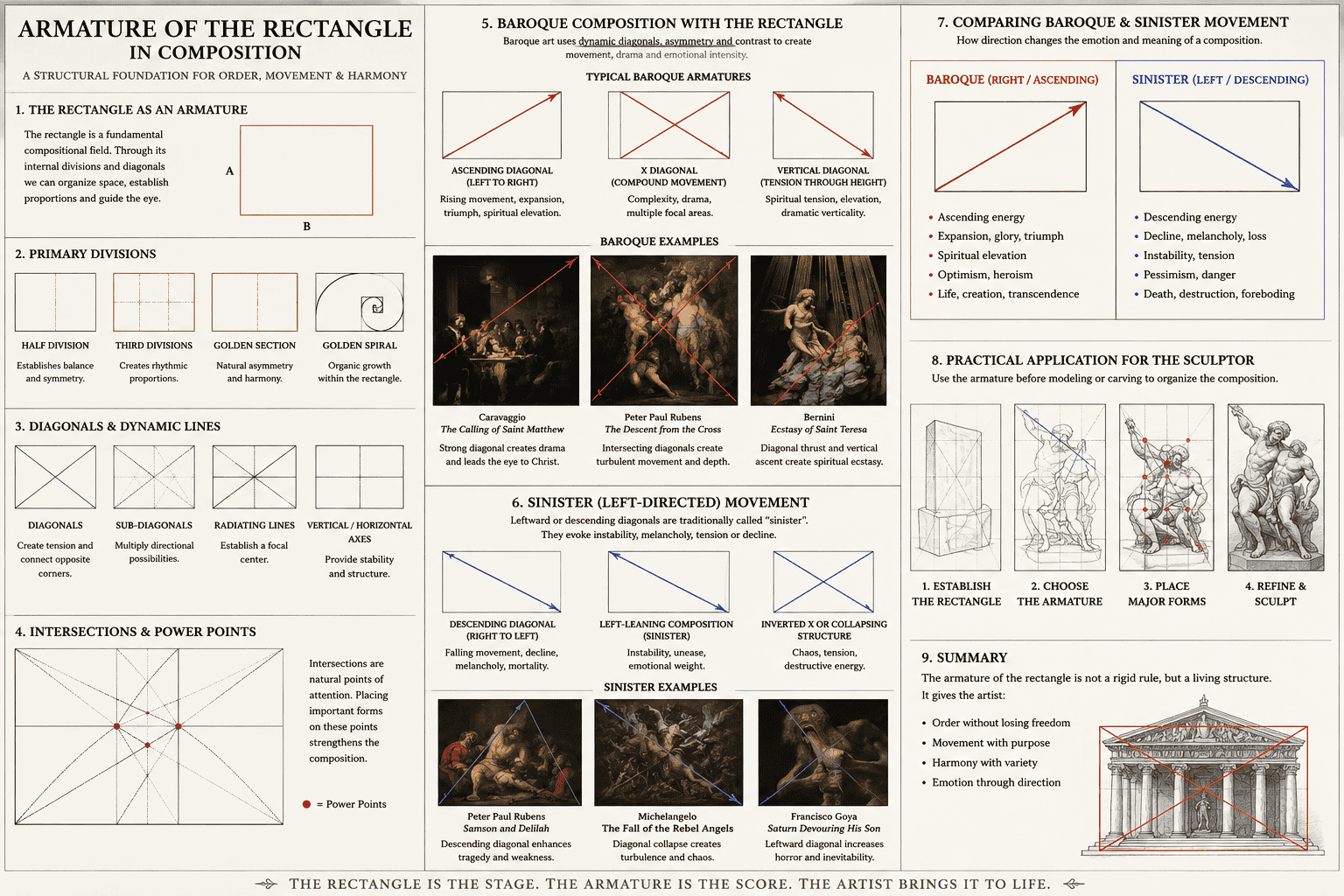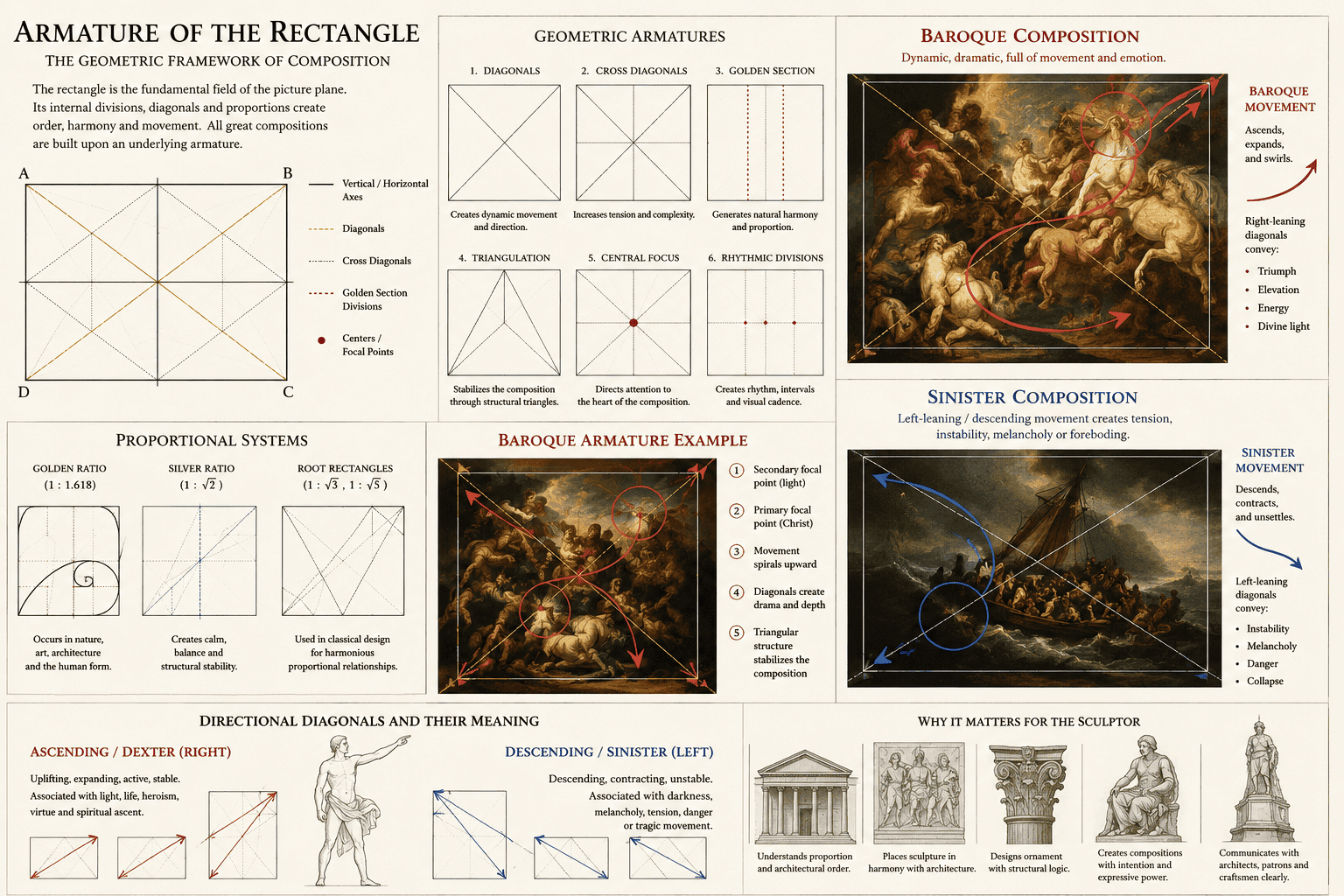
Armature of the Rectangle — A compositional framework based upon the internal geometric divisions, diagonals, reciprocals, and proportional relationships contained within a rectangle. Used in drawing, painting, sculpture, architecture, and design, the armature of the rectangle helps organize visual movement, balance, rhythm, focal points, and spatial harmony within a composition.
Classical and academic artists have long employed rectangular armatures to guide the placement of major forms and directional forces within an image. Dynamic diagonals may create ascending, descending, stable, or turbulent visual movement depending upon their orientation and proportional relationships.
In Baroque composition, diagonal movement often becomes highly active and theatrical, generating emotional energy, tension, and dramatic spatial flow. Right-leaning ascending diagonals are traditionally associated with movement, expansion, heroism, or triumph, while left-leaning or descending diagonals — sometimes referred to as sinister movement — may evoke instability, melancholy, tension, foreboding, or collapse. These directional forces play an important role in the psychological and symbolic reading of a composition.
The armature of the rectangle serves not merely as a geometric device, but as an underlying structural order through which visual harmony, movement, and expressive intention are orchestrated.